

Cocaine can be detected anywhere from2 days to 90 days, depending entirely on the type of test being administered and your history of use. However, a simple number does not tell the whole story.
To understand drug testing, one must understand how the human body (specifically the liver and kidneys) works as a biological filtration system. When a drug test is performed, it is rarely searching for the active cocaine molecule; instead, it is hunting for metabolites, which are the chemical byproducts created as your body breaks the drug down into manageable waste.
How Does the Body Process Cocaine into Metabolites?
To grasp why cocaine lingers, we must look at the chemistry of metabolism. When cocaine enters the bloodstream, the liver immediately begins a process of deconstruction. The primary metabolite created during this process is benzoylecgonine.
Benzoylecgonine is the industry standard for cocaine testing. While active cocaine has a half-life of only about one hour (meaning half of the drug is gone every 60 minutes), benzoylecgonine has a half-life of approximately 6 to 12 hours.
This means it stays in your bodily fluids much longer than the parent drug. Because benzoylecgonine is chemically stable and unique to cocaine consumption, it leaves a clear, detectable trail that laboratories can identify with high precision.
What Happens When You Mix Cocaine and Alcohol?
A critical and often overlooked aspect of detection is what happens when cocaine is mixed with alcohol. This is a common combination in social settings, but from a biological standpoint, it creates a much more complex situation. When these two substances are present in the liver simultaneously, the body produces a third, unique metabolite called cocaethylene.
Cocaethylene is significantly more toxic to the heart than cocaine or alcohol alone, and it has an even longer half-life than benzoylecgonine. This means that if you drink while using, you are not just increasing the health risks; you are potentially extending your detection window.
If a specialized laboratory test is looking for cocaethylene, the evidence of use can be detected for several days longer than if you had used cocaine in isolation. This compound takes significantly more time for the liver to process and for the kidneys to eventually flush out.
How Long Can Cocaine Be Detected by Different Drug Tests?
The timeframe for which cocaine use can be identified is governed primarily by the biological sample being tested. Different tissues and fluids hold onto metabolites for vastly different periods.
How Long Does Cocaine Stay in Your Urine?
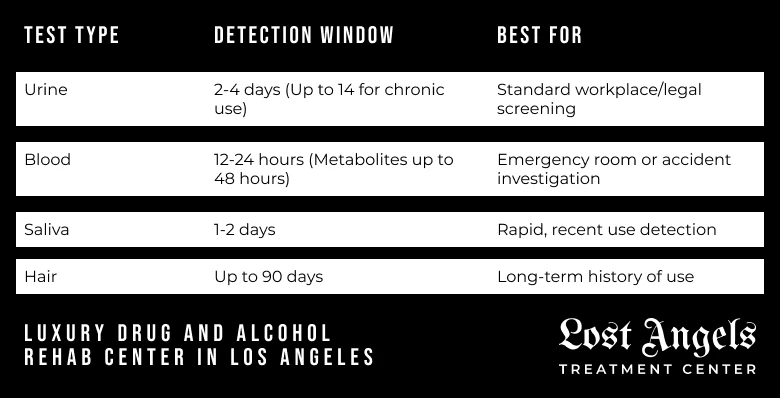
Urine testing is the standard for most workplace, legal, and clinical screenings. It is preferred because it is non-invasive, cost-effective, and offers a relatively wide window of detection compared to blood or saliva.
For most people, cocaine and its primary metabolite, benzoylecgonine, can be detected in urine for about 2 to 4 days after the last use. However, this period can extend significantly for those who use cocaine frequently or in larger amounts.
Heavy or chronic users might find cocaine detectable in their urine for up to 14 days, or even longer in extreme cases. This extended detection is due to the body’s slower elimination of metabolites when they have built up in the system over time.
How Long Is Cocaine Detectable in Your Blood?
Blood tests are effective at detecting very recent cocaine use because the drug enters the bloodstream rapidly. However, because the blood is constantly being filtered and recirculated, the detection window is quite narrow. Cocaine itself can typically be detected in blood for up to 24 hours, and its metabolites may linger for up to 48 hours (2 days).
Blood tests are rarely used for routine screenings because they are invasive and expensive. They are most often used in medical emergencies, such as an overdose, or in legal investigations where it is necessary to prove immediate impairment, such as after a vehicle accident.
How Long Does Cocaine Stay in Your Saliva?
Saliva tests, also known as oral fluid tests, offer a convenient and hard-to-tamper-with way to screen for cocaine. They can detect the presence of the drug almost immediately after use, often within minutes.
The detection window for cocaine in saliva is typically shorter than for urine tests, usually ranging from 1 to 2 days after the last use. These tests are becoming more common for roadside testing and random workplace checks because they reflect what has happened in the very recent past.
Can a Hair Test Detect Cocaine Use from Three Months Ago?
Hair follicle testing provides the longest look-back period for cocaine detection. As the hair grows, drug metabolites from the bloodstream become trapped in the hair shaft. A standard hair test uses a 1.5-inch sample of hair taken from the scalp, which represents approximately 90 days (three months) of growth.
It is important to note that hair tests are not suitable for detecting very recent use. It takes several days for the contaminated hair to grow above the scalp line where it can be collected. However, once the metabolites are in the hair, they are essentially permanent records until that hair is cut or falls out.
What Factors Affect How Long Cocaine Stays in Your System?
Detection windows are influenced by a variety of personal factors. This is why two people can take the same amount of a substance, yet one may test clean days before the other.
Dosage and Frequency of Use
For someone who uses cocaine regularly or is struggling with a dependency, the metabolites build up in the body’s tissues, making them detectable for much longer periods compared to a one-time user.
Think of it like a filtration system: if you pour a small amount of waste into a filter, it clears quickly. If you keep pouring it in without stopping, the filter becomes saturated and the process slows down.
Metabolism and Body Weight
Everyone’s body processes substances at a different speed. Your metabolism—how fast your body burns energy and performs its internal maintenance—plays a big role.
People with faster metabolisms tend to eliminate substances more quickly. Body weight and composition also matter.
Cocaine metabolites can sometimes get stored in body fat. This means people with a higher body fat percentage might retain these metabolites for a slightly longer duration than those with lower body fat.
Overall Health and Organ Function
Your liver is the body’s main processing plant for breaking down substances, and your kidneys are the final exit route. If your liver isn’t functioning optimally due to age, health conditions, or long-term substance use, it can take much longer for cocaine and its metabolites to be processed.
Similarly, healthy kidney function is essential for flushing those waste products out through your urine. Any underlying condition that affects these organs will naturally influence how long cocaine stays detectable in your system.
Hydration Levels
While staying hydrated is vital for overall health and cognitive function, it also helps your kidneys function more efficiently. When you drink enough water, your kidneys can flush out waste products, including drug metabolites, at a steady rate.
Conversely, being dehydrated can slow down the elimination process. However, it is a myth that drinking massive amounts of water just before a test will clean your system; labs can detect diluted samples, which often leads to an invalid result.
Are Detox Drinks Effective for Passing a Cocaine Drug Test?
If you are concerned about a drug test, you might be tempted to try “detox drinks” or extreme hydration to speed up the process. It is important to understand that these methods are largely unreliable and can often cause more problems than they solve.
Your body processes cocaine at a fixed rate dictated by your liver enzymes. There is no magic drink or supplement that can force your liver to work five times faster than its biological capacity.
Most products sold as detox kits are simply diuretics that make you urinate more frequently or supplements that try to mask the dilution of your urine. Laboratories are highly sophisticated and check for things like creatinine levels and specific gravity.
If your sample looks like water or has abnormal chemical markers, it will be flagged as diluted or adulterated. In many employment and legal settings, a diluted sample is treated with the same suspicion as a positive result.
What Is the Difference in Detection Between Occasional and Heavy Users?
To put the detection windows into a practical context, we have to look at the user’s habits. For an occasional user the body is generally efficient at clearing the substance. In these cases, a urine test will almost certainly be negative after four or five days of abstinence.
For a heavy or chronic user, the situation is different. When cocaine is used daily, the body never has a chance to fully clear the previous dose before the next one arrives. This leads to a steady-state concentration in the body where metabolites are continuously present.
In these scenarios, the detection window in urine can easily stretch to two weeks. The body is essentially playing a game of “catch-up” that it can only win once the person stops using entirely and gives their organs the time they need to finish the job.

How Does the Fear of Drug Testing Impact Mental Health?
Beyond the chemical facts of drug testing lies the psychological reality of detection anxiety. For many people, the stress of calculating detection windows and worrying about a surprise test becomes a dominant force in their lives.
This anxiety is often a warning light for a larger problem. When the fear of failing a drug test, and the potential loss of a job, a relationship, or legal standing becomes a constant source of stress, it indicates that the substance use has moved from a choice to a problematic dependency.
Living in a constant state of “detection avoidance” is exhausting. It takes up mental energy that could be spent on your career, your family, and your personal growth.
If you are spending hours researching how to beat a test, it may be time to look at the underlying reasons for that use. Drug tests are simply snapshots of a moment in time, but the stress and anxiety of use are ongoing burdens that affect your quality of life every single day.
What Is the Best Way to Clean Your System After Cocaine Use?
If you are worried about cocaine detection, the most reliable and long-term solution is not a detox kit or a hydration strategy; it is allowing your body the time it needs to heal. Your liver and kidneys are incredibly resilient, but they need a break from the constant influx of stimulants to function at their best.
Professional support can make this transition significantly easier. Many people find that the crash and the initial days of abstinence are the hardest part to navigate alone.
Therefore, seeking help from a specialized treatment center allows you to go through the detox process in a safe, medically supervised environment. This takes the guesswork out of the process and ensures that your body is recovering in the most efficient way possible.
Why Is Medically Supervised Detox Necessary for Cocaine Recovery?
At Lost Angels, we understand the science of addiction and the mechanical reality of how drugs like cocaine affect the body and brain. We recognize that the anxiety over drug testing is often the tipping point that leads people to seek change.
That’s why our approach is rooted in both empathy and clinical expertise. We provide a space where you don’t have to worry about detection windows because we are focused on the much more important goal: your long-term stabilization.
Medically supervised detox is particularly important for cocaine because of the profound psychological and cardiovascular stress the drug places on the system. Our team monitors your health and provides the clinical scaffolding needed to navigate the early phases of recovery safely. We help you move past the “detection anxiety” phase and into a life where you no longer have to calculate half-lives or worry about a sample.
References
- ScienceDirect. (n.d.). Benzoylecgonine. https://www.sciencedirect.com/topics/medicine-and-dentistry/benzoylecgonine
Frequently Asked Questions
How long can cocaine be detected in a drug screen?
The length of time cocaine can be detected varies significantly by the type of drug test used. Generally, urine cocaine tests show a window of 2 to 4 days, while a blood test for cocaine is narrower, usually around 24 to 48 hours. For a long-term look-back, tests for cocaine can detect metabolites in hair follicles for up to 90 days.
What is the primary cocaine metabolite benzoylecgonine?
When the body processes cocaine, the liver breaks the substance down into metabolites. The cocaine metabolite benzoylecgonine is the most stable byproduct and is the target of almost every drug screen because it remains detectable in the system much longer than cocaine itself.
Does using cocaine with alcohol affect the detection window?
Yes. Using cocaine with alcohol creates a unique compound called cocaethylene. This substance is more cardiotoxic and has a longer half-life, meaning the effects of cocaine and alcohol together can cause the drug to stay in the system longer than if used alone.
Can heavy cocaine use extend the drug test window?
Absolutely. While an occasional user might test positive for cocaine for only a few days, heavy cocaine use leads to a cumulative build-up. In cases of repeated cocaine use, the elimination of cocaine slows down, and metabolites may show up in urine for up to two weeks or more.
Does the method of use affect how long cocaine stays in the system?
Whether someone is snorting cocaine, smoking crack cocaine, or injecting cocaine, the method of use primarily dictates the onset of the high. However, because cocaine is a fast-acting stimulant, the body begins metabolizing cocaine almost immediately regardless of how it entered the central nervous system.
Is it possible to "flush" cocaine or its metabolites out of your system?
There is a common myth that extreme hydration can eliminate cocaine quickly to avoid testing positive for cocaine. However, cocaine metabolism is a fixed biological process. While hydration supports kidney function, laboratories often flag diluted samples in a cocaine drug test, which can be treated as a failed drug screen.
What are the symptoms of cocaine withdrawal?
Cocaine withdrawal is primarily psychological and occurs as the stimulant drug leaves the person`s system. Cocaine withdrawal symptoms typically include intense fatigue, depression, and severe cravings for cocaine. Because cocaine is a powerful stimulant, the "crash" can be profoundly distressing, often requiring professional treatment for cocaine addiction.